Showing posts with label policy. Show all posts

Tuesday, March 16, 2021

Plans to Ban Natural Gas in NY

Everyone knows it's not smart to put all your eggs in one basket. You risk complete loss if something goes wrong with that basket. But that is exactly what New York State is planning to do with building electrification through its proposed ban on natural gas.

Recently, the Energy Efficiency and Housing Advisory Panel published "Preliminary Draft Proposal Recommendations Under Consideration" which lists several plans to ban future natural gas use in buildings (Fig. 1). No gas space heating or water heating in new construction. No gas space heating or water heating end-of-life replacements in existing buildings. No gas replacements for cooking or clothes drying appliances.  That's no gas allowed at all.
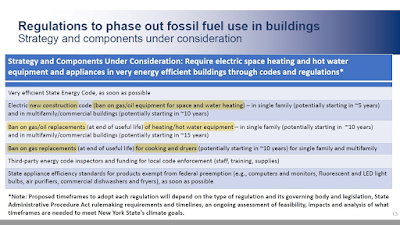
Energy Efficiency and Housing: Public Engagement Session presentation 2/4/21 p. 13


Figure 1. Page 13 of the Preliminary Draft Proposal Recommendations Under Consideration (1). Highlights added.

The Energy Efficiency and Housing Advisory Panel is a subcommittee of the Climate Action Council empowered by the ambitious New York Climate Leadership and Community Protection Act of 2019. The proposed gas bans are phased-in over the next 5 to 15 years in order to meet the Act's climate goals.

This command and control policy won't achieve the goals without serious unintended consequences. Consumers will rush to purchase and install gas technologies before the new bans take effect, undermining the purpose of the ban. Concurrent policies to increase the share of renewable wind and solar energy are being implemented, making electricity more expensive in NY. Importantly, relying solely on electricity for space heating puts NY residents in drafty buildings at risk from freezing during a blackout.

Such a shift in the way New Yorkers operate all their aging buildings in this short timeframe is improbable. Current technology being pushed comes in the form of all-electric ground-source heat pumps and cold climate air-source heat pumps. While these technologies are capable of providing comfortable interior environments in the context of holistic building design under normal operating conditions, they are expensive to install and maintain.

During the recent public comment period for the gas ban proposal, serious doubts were put forth regarding the functionality of alternative technologies in a variety of circumstances. Simply replacing gas burning furnaces and appliances with all-electric options may not work as intended. In the absence of super-insulated and tightly sealed building envelopes, heat pumps lose heat transfer efficiency in cold temperatures and need to run continuously. Their compressor oil needs to be heated by electric resistance to avoid mechanical failure. At extremely low temperatures, electric resistance backup heat is required, which is the least efficient and most expensive to operate. These factors put a greater load on the electric grid when it's needed most, increasing the risk of catastrophic failure and expense of operation. Heat pumps may not be able to keep up in some extreme conditions, such as a polar vortex, which climate models increasingly forecast.

A better policy approach is to continue to provide market incentives to encourage those who want and can afford all efficient technologies, including gas combined heat and power systems and climate-negative biofuels, to install them more easily. Funding research and development for future innovative solutions, such as better performing refrigerants, should be increased in an effort to make our buildings and energy systems better. 

~ Mark Bremer, Green Explored contributor

(1) Energy Efficiency and Housing: Public Engagement Session presentation, February 4, 2021. https://climate.ny.gov/-/media/CLCPA/Files/2021-02-04-EEH-Public-Engagement-Session.pdf

Sunday, April 17, 2011

Extended Producer Responsibility Laws Reduce E-Waste

Why are Extended Producer Responsibility (EPR) policies an effective method for reducing hazardous electronic (e-) waste? Challenging the Chip: Labor Rights and Environmental Justice in the Global Electronics Industry1 describes EPR as policy instruments “that hold manufacturers accountable for the full costs of their products at every stage in their life cycle” (p.247). Equipment is taken back at the end of its useful life by the producer, or hired contractor, for recycling. This way, products containing environmental or health-damaging components will not contribute to pollution in landfills, incinerators, or in the informal recycling system (exposure for scrap pickers). Producers are forced to internalize the costs of disposal and, therefore, are more likely to implement product design changes to minimize non-recyclable and hazardous materials.

The European Union (EU) passed two directives in 2003 dealing with electronic wastes. The Directive on Waste Electrical and Electronic Equipment (WEEE) made manufacturers responsible for managing e-waste disposal. The Restrictions on the Use of Certain Hazardous Substances in Electrical and Electronic Equipment (RoHS) phased-out the use of hazardous materials in such equipment (p.265). Why does EPR work? First, these restrictions created a market opportunity for companies to sell their products in the EU and beyond. It would have been prohibitively expensive for manufacturers to have separate non-hazardous and hazardous product lines. Plus firms did not want to face bad publicity or liability for hazardous versions of their products (p.248). So they anticipated legislative changes and redesigned their entire product lines. Second, individual manufacturer responsibility rules forced companies to fully internalize the cost of e-waste disposal. This drove the innovations in design that reduced disposal costs and fostered ease of recycling (p.275).

While the EU was successful in instituting the EPR directives above, similar policies face implementation obstacles in the United States. Powerful industry associations, like the Electronics Industry Alliance (EIA), have argued for voluntary recycling programs and defended the use of certain materials in electronic products (p.266). The American Electronics Association (AEA) resisted sharing up-front costs of recycling. They also claimed material bans would undermine the functionality, reliability, and safety of their products (p.248). Furthermore, they sought help from the federal government’s U.S. Trade Representative (USTR) who put counter pressure on the EU, saying the regulations violated the General Agreement on Tariffs and Trade (GATT) and were “unnecessary barriers to trade” (p.248-9). In a later affront to EPR, the Central American Free Trade Agreement (CAFTA) prohibited the federal government from adopting preferences for environmentally sustainable products (p.257).

EPR’s success in the U.S. depends on organizations’ ability to attract more industry support, like that won from Hewlett-Packard and Dell in the 2001 Computer TakeBack Campaign (p.250). In addition, strong state (and eventually national) laws that reflect the true spirit of EPR must be enacted to force manufacturers to internalize the costs of toxic materials in their bottom lines.

~Mark Bremer, Green Explored Contributor

-------------------

[1] Smith, T., Sonnenfeld, D., Pellow, D. Hightower, J (2006). Challenging the Chip: Labor Rights and Environmental Justice in the Global Electronics Industry. Temple University Press. Philadelphia, Pa.

Sunday, March 20, 2011

China's membership in WTO exacerbates environmental problems

Since 1978, China’s rapid industrialization and trade liberalization policies have led to the country becoming the international dumping ground for environmentally damaging pollutants and dangerous hazardous wastes. China’s accession to the World Trade Organization (WTO) in 2001 has only exacerbated its ecological problems1. Since then the scale of economic activity has grown to more than offset technological gains in efficiency. Overall, compliance with environmental regulations is lax due to institutional weakness. In addition, the income gap is widening causing threats to the environment by escalating consumerism and high unemployment survival strategies1. Radical policy changes are needed to address China’s worsening environmental problems.

China’s industrial structure and natural resource endowments have favored pollution-intensive growth in coal energy production to meet the rapidly expanding energy demand of the exploding manufacturing sector. Air pollution has increased dramatically from the growth in coal and automobile industries. Small, low-tech, labor-intensive textile operations produce particularly dirty industrial sewage. Small firms account for the vast majority of production and are difficult to regulate and monitor1. These structural and resource factors have made China a free-for-all ‘pollution haven’ within an explicitly expansionist economic policy.

Numerous improved environmental standards have been adopted, but feebly enforced due to institutional weakness. China’s administrative structure is highly fragmented allowing economic ministries to focus on the “pursuit of narrow sectoral objectives with little consideration for the environment”2. Enforcing environmental regulations became even harder as the industrial ministerial structure was dismantled in the transition to comply with WTO rules1. In effect, the lack of enforcement has caused a ‘regulatory race to the bottom’ as China competes for foreign investment.

Socio-economic changes brought about by China’s WTO membership have magnified some environmental problems. China’s economic growth due to the reduction in trade barriers has boosted incomes of its urban populace and caused them to increase consumption of food, goods, and energy. On the other hand, high unemployment and reduced purchasing power means many people are engaged in heavily-polluting natural resource extraction survival strategies1.

China’s membership in the WTO will continue to allow a rapid expansion in the scale of industrialization and intensive energy consumption at the expense of the environment. Only a radical policy change could alter China’s trajectory of environmental degradation. Sudden crises such as food safety scares, climate change effects, or natural resource scarcity have the potential to cause large enough public concern for officials to contemplate serious policy changes. Or when a large social movement demands enforcement of environmental regulations, China may begin to prioritize environmental protection. Until then, China is unlikely to enhance regulatory enforcement or choose to fundamentally shift its development away from environmentally destructive practices.

~Mark Bremer, Green Explored Contributor

--------------------

[1] Jahiel, Abigail R.(2006) 'China, the WTO, and implications for the environment', Environmental Politics, 15: 2, 310 — 32.

[2] Carter, Neil. 2007. The Politics of the Environment: Ideas, Activism, Policy. 2nd ed. New York: Cambridge University Press (p.189)

Sunday, February 27, 2011

Genetically Modified Crops in China

China faces unique challenges in regulating genetically modified (GM) crops for commercial agriculture. China has world-class biotechnology research and development capacity and has made several important advancements in the field. At the same time, China faces mounting challenges in the implementation and enforcement of biosafety regulations. Market economy pressures, administrative fragmentation, and lack of transparency in policymaking contribute to China’s difficulties. Recent changes in China’s biotechnology policies4 will broaden the commercial use of GM food crops, but will likely cause little improvement in China’s biotechnology governance capacity.

Several key biotechnology achievements have been made by Chinese researchers, but China lags behind the world in large-scale commercial distribution of GM food crops2. Cotton engineered with the natural insecticide gene from the bacterium Bacillus thuringensis (Bt) has been widely distributed in China since its approval in 19981, along with limited use of five other GM crops2. However, GM corn and rice were only approved in 20093, despite development of these strains in state institutions, extensive field trials, and pressure from key proponents in the 863 and 973 committees that fund and regulate GM research1.

China has closed networks of people responsible for the funding, research, promotion, and regulation of GM crops in government-organized groups which James Kelley calls the biotechnology discourse coalition1. This network is notorious for its lack of transparency and certainly has the appearance of a conflict of interest in the decision making process1. Nonetheless, decisions coming out of this network show disparate results depending on the GM crop. Factors in China’s caution toward Bt rice include economic worries about global trade bans and labeling requirements, scientific uncertainty towards potential genetic drift into diverse traditional rice strains, increased public interest in potential changes to their staple food, as well as regulatory concern for illegal planting of GM seeds.

China’s National People’s Congress is ready to install a new set of rules governing the “production, development, and research of GM grains”4. But despite tough biosafety rules requiring field testing for at least three growing seasons before certification5, doubt remains about the enforceability of GM crop regulations in China. Administrative fragmentation continues to tangle China’s governance of biosafety issues as numerous Ministries vie for influence.

The fact that China has dealt with commercialization of GM food crops more cautiously than many western countries emphasizes the delicate balance China is trying to strike in its approach to regulating GM crops. Despite China’s attempts to further regulate the growing biotechnology industry, it is now opening up GM food crops to widespread cultivation and will be unlikely to effectively assert regulatory control over them.

~Mark Bremer, Green Explored Contributor

---------------

[1] Keeley, James (2006) 'Balancing technological innovation and environmental regulation: an analysis of Chinese agricultural biotechnology governance', Environmental Politics, 15: 2, 293 — 309

[2] GMO Compass 3/29/10 “Genetically modified plants: Global cultivation on 134 million hectares”

[3] Reuters 11/27/09China gives safety approval to GMO rice”

[4] Reuters 12/27/10 “China mulls GMO food law, grain law ready in 2011”

[5] Robert F. Durant, Daniel J Fiorino, and Rosemary O’Leary (eds.) Environmental governance reconsidered: challenges, choices, and opportunities. 2004. MIT Press. (pg.121)

Sunday, February 20, 2011

China National Model Cities for Environmental Protection

China has conducted some interesting experiments in environmental policy initiatives and innovations. In 1989, the Urban Environmental Quality Examination System (UEQES) began providing annual assessments of the environmental performance of major Chinese cities. Then, in 1997, the National Model City (NMC) for Environmental Protection program was initiated. While the ability to acquire foreign investment in environmentally-friendly technologies has contributed to the naming of cities as NMCs, relocation of heavily-polluting industries outside of coastal cities to gain NMC points has merely displaced many environmental problems elsewhere. China’s overall environmental protection capacity will not be solely determined by NMC awards and its credibility will continue to be hurt by technical weaknesses.

To attain status as a NMC, a set of specific environmental and development targets must be met. Among these are metrics of how the city handles energy supply, manages waste, preserves green space, funds environmental protection, and rates among surveys of its citizens1. To date, dozens of Chinese cities and several urban districts have achieved NMC status2, demonstrating Chinese local officals’ capacity to develop their economies while protecting their cities’ environments.

Shenyang is an example of an impressive success in the NMC program. It was one of China’s most polluted cities in 19841. In a dramatic turnaround, officials began upgrading or relocating downtown factories and building wastewater treatment plants starting in 2001. By 2003, Shenyang had increased its good air quality days by 84% and by 2004 it had achieved NMC status1. With the prestige of the award, the local mayor was then able to attract the International Horticultural Exposition in 2006 and entice further foreign investment1.

International cooperation is a key part of the success of China’s NMC program. Japanese banks provided some funding for three initial test cities and Japanese government agencies gave technical assistance1. Partnership with the European Union has helped Nanjing develop low-carbon industries3. Singapore’s Surbana Urban Planning Group is developing plans for the striking new Tianjin Eco-City to be completed by 20204. The UK’s Arup Group is designing the proposed Dongtan Eco-City outside of Shanghai5.

Serious problems with the NMC system, however, have been identified. Zhongshan was able to win NMC status, in part, because officials moved environmentally-polluting industries outside of the city’s evaluation area1. Furthermore, it seems China’s air pollution emissions are not even measured, but rather estimated, and have the potential for compromised data1. General lack of transparency and few opportunities for citizen participation in the decision-making process contribute to the weakness of China’s environmental policies.

China’s NMC system is a progressive environmental policy idea utilizing strong international assistance to improve urban environments, but technical weaknesses bring China’s overall environmental protection capacity into question.

~Mark Bremer, Green Explored Contributor

-------

[1] Economy, Elizabeth(2006) 'Environmental governance: the emerging economic dimension', Environmental Politics, 15: 2, 171 — 18

[2] China State Environmental Protection Administration, National Model Cities for Environmental Protection

[3] ChinaDaily.com “Nanjing: Host city is investors’ favorite”

[4] Inhabitat.com “Tianjin Eco City is a Futuristic Green Landscape for 350,000 Residents”

[5] SustainableCities.dk “Dongtan: the world’s first large-scale eco-city?”

Sunday, February 6, 2011

Do environmental impact assessments help protect the environment?

Does the environmental impact assessment (EIA) administrative tool help protect the environment? EIA is a systematic process of evaluating environmental consequences of a proposed development project or management plan. In concept, EIA provides the information necessary to minimize environmental problems of proposed actions and encourages collaboration among the stakeholders in environmentally controversial decisions. Author Neil Carter, in The Politics of the Environment, explains that while EIA brings environmental concerns into the decision-making process in a rational way and encourages policymakers to preemptively address environmental impacts of their proposals more routinely, it “contains fundamental conceptual and technical weaknesses that render it vulnerable to charges of bias, unreliability, and imprecision”(p.302). I believe EIA is an important process for policymakers to engage in and will often, but not always, lead to some environmental benefit.

In the US, when a proposed Federal action could affect the environment, the National Environmental Policy Act of 19691 requires an investigation into the potential environmental, human health, and socio-cultural effects of the proposed action, as well as alternative actions. EIA is designed to provide information about how to avert or reduce negative environmental impacts of actions such as construction of public work projects, changes to public lands management plans, or permits for development2. Countries of the European Union have also enacted EIA legislation3.

When carried out appropriately, EIA is good because it involves a wide array of stakeholders in policy discussions. It allows environmental groups and the general public to get involved in the decision making process for proposals that affect them. If done sufficiently in advance, the EIA gives them access to information in agency draft reports, and the power to comment and apply for judicial review. This type of democratic inclusion does not usually stop a project from proceeding, especially when backed by powerful economic interests. In practice, only a well-organized and informed public interest or environmental group can intelligently comment due to the typically highly technical nature of the draft reports. However, this transparency in the process increases the chances that the proposal will attempt to minimize environmental damage.

Whereas risk assessment considers often inconclusive scientific data and cost-benefit analysis evaluates only economic issues, EIA takes into account wider concerns, such as potential social and cultural impacts of a project. EIA is the most likely of these administrative tools to capture environmental justice issues. However, the authority of an EIA can be hurt by this non-quantitative approach, potentially biased source material (EIAs are often outsourced), and ambiguity in its findings (p.302).

EIA doesn’t guarantee environmentally favorable outcomes. Entities captured by powerful economic interests can manipulate EIA to deliver on their own political ends. Policymakers could and do use an EIA to give the mere appearance of rationality to their decision making (p.303) or ignore the alternatives and enact a proposal with negative environmental impacts.

Done properly, an EIA is basically an informational tool to force policymakers to think about environmental concerns. It should increase the likelihood developers will anticipate environmental objections and subsequently modify their proposals. EIA can slowly creep environmental concerns into the social radar of planners and some environmental protection, however small, may result from their participation in the process.

~Mark Bremer, Green Explored Contributor

-----

1 http://ceq.hss.doe.gov/welcome.html (accessed 1/30/11)

2http://www.eoearth.org/article/Environmental_Impact_Assessment (accessed 1/31/11)

3http://eur-lex.europa.eu/LexUriServ/LexUriServ.do?uri=CELEX:32001L0042:EN:HTML (accessed 1/31/11)

Sunday, January 30, 2011

Insider vs. outsider impact on environmental policy

Do insider or outsider strategies make a more substantive impact on environmental policy? In chapter 6 of The Politics of the Environment, author Neil Carter is hesitant to make any firm conclusions about the substantive impact of insider strategies, but does declare that outsider grassroots campaigns are seldom the deciding factor in the wider environmental policy arena (p.176). I believe pursuing insider strategies have had a mild sensitizing impact, but helped little to achieve material results. Significant pressure from grassroots campaigns and protest actions are required for environmental policy victories.

An insider strategy is one in which environmental lobbyists seek to influence policy decisions from the inside in consultation with government ministers. Carter (p.166) points out environmental groups have gotten only limited access, and where there is regular access this kind of strategy inherently involves compromise of values and playing by the rules of the game- basically dealing with the devil. Furthermore, access is only temporary and can be lost when the elected administration changes, ie. Clinton to Bush in 2000. Even where green parties have been part of the government, as in Germany, access was barely improved.

Institutionalization of environmental groups has certainly increased (p.148). Environmental values have been generally accepted as part of the political discourse. Environmental organizations have grown in membership and funding. Organizations like Friends of the Earth (p.152) have become more professional and centralized as well as shifted their strategy from direct confrontational actions toward more lobbying and monitoring. These advancements have led to an increased public awareness of environmental issues and helped shape political considerations of the environment.

However, the environmental lobby has largely failed to enact its proposed policy reforms as it runs up against very powerful corporate and producer interests. In the US, the environmental lobby never achieved ratification of greenhouse gas emissions controls sought by the Kyoto Protocol legislation1. Energy producers have a stronger insider-presence in most governments and often get their desired mining permits approved with waivers on environmental review2.

There are isolated incidences where insider strategies have helped block environmentally harmful development projects (167). But most environmental achievements are often in large part due to strong conventional grassroots campaigns and media attention from unconventional actions that exert considerable pressure on policy decisions. In the US, both pressure-group politics and swelling public opinion are credited for the enactment of the major pollution control bills of the 1970s 3. In Germany, popular anti-nuclear campaigns halted transport of nuclear waste and building of nuclear reactors4. A Greenpeace anti-whaling campaign that began in 1975 ultimately resulted in a moratorium on commercial whaling and creation of whale sanctuaries5. The insider environmental lobby probably had a facilitating role in these grassroots successes. But without strong pressure from outside mass social campaigns and attention-grabbing actions, insider environmental lobbying alone has exercised little influence.

~Mark Bremer, Green Explored Contributor

___

1http://www.carbonify.com/articles/kyoto-protocol.htm (accessed 1/24/11)

2http://www.biologicaldiversity.org/news/press_releases/2010/post-disaster-permits-05-07-2010.html (accessed 1/24/11)

3http://www.pollutionissues.com/Pl-Re/Politics.html (accessed 1/24/11)

4http://www.greenkids.de/europas-atomerbe/index.php/Anti-nuclear_Movement_in_Germany#Was_this_a_political_decision_or_was_it_brought_about_by_anti-nuclear_pressure.3F (accessed 1/24/11)

5http://www.greenpeace.org/international/en/campaigns/oceans/whaling/campaign-history/ (accessed 1/24/11)