Showing posts with label Bremer. Show all posts

Tuesday, March 16, 2021

Plans to Ban Natural Gas in NY

Everyone knows it's not smart to put all your eggs in one basket. You risk complete loss if something goes wrong with that basket. But that is exactly what New York State is planning to do with building electrification through its proposed ban on natural gas.

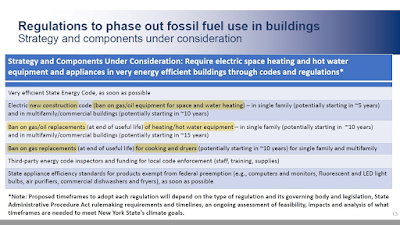
Recently, the Energy Efficiency and Housing Advisory Panel published "Preliminary Draft Proposal Recommendations Under Consideration" which lists several plans to ban future natural gas use in buildings (Fig. 1). No gas space heating or water heating in new construction. No gas space heating or water heating end-of-life replacements in existing buildings. No gas replacements for cooking or clothes drying appliances.  That's no gas allowed at all.

Energy Efficiency and Housing: Public Engagement Session presentation 2/4/21 p. 13


Figure 1. Page 13 of the Preliminary Draft Proposal Recommendations Under Consideration (1). Highlights added.

The Energy Efficiency and Housing Advisory Panel is a subcommittee of the Climate Action Council empowered by the ambitious New York Climate Leadership and Community Protection Act of 2019. The proposed gas bans are phased-in over the next 5 to 15 years in order to meet the Act's climate goals.

This command and control policy won't achieve the goals without serious unintended consequences. Consumers will rush to purchase and install gas technologies before the new bans take effect, undermining the purpose of the ban. Concurrent policies to increase the share of renewable wind and solar energy are being implemented, making electricity more expensive in NY. Importantly, relying solely on electricity for space heating puts NY residents in drafty buildings at risk from freezing during a blackout.

Such a shift in the way New Yorkers operate all their aging buildings in this short timeframe is improbable. Current technology being pushed comes in the form of all-electric ground-source heat pumps and cold climate air-source heat pumps. While these technologies are capable of providing comfortable interior environments in the context of holistic building design under normal operating conditions, they are expensive to install and maintain.

During the recent public comment period for the gas ban proposal, serious doubts were put forth regarding the functionality of alternative technologies in a variety of circumstances. Simply replacing gas burning furnaces and appliances with all-electric options may not work as intended. In the absence of super-insulated and tightly sealed building envelopes, heat pumps lose heat transfer efficiency in cold temperatures and need to run continuously. Their compressor oil needs to be heated by electric resistance to avoid mechanical failure. At extremely low temperatures, electric resistance backup heat is required, which is the least efficient and most expensive to operate. These factors put a greater load on the electric grid when it's needed most, increasing the risk of catastrophic failure and expense of operation. Heat pumps may not be able to keep up in some extreme conditions, such as a polar vortex, which climate models increasingly forecast.

A better policy approach is to continue to provide market incentives to encourage those who want and can afford all efficient technologies, including gas combined heat and power systems and climate-negative biofuels, to install them more easily. Funding research and development for future innovative solutions, such as better performing refrigerants, should be increased in an effort to make our buildings and energy systems better. 

~ Mark Bremer, Green Explored contributor

(1) Energy Efficiency and Housing: Public Engagement Session presentation, February 4, 2021. https://climate.ny.gov/-/media/CLCPA/Files/2021-02-04-EEH-Public-Engagement-Session.pdf

Tuesday, October 2, 2018

Kavanaugh's Environmental Record and Lack of Judicial Temperament

The recent spectacle on display in the Senate Judiciary Committee hearings is an unfortunate distraction from the substantive task of determining Kavanaugh's judicial suitability for the Supreme Court. In other words, would he be a fair judge? We should look to Kavanaugh's judicial record on a number of issues to determine the answer.

On the environment, Kavanaugh repeatedly sides with industry and against regulatory authority. Kavanaugh's preference to side with industry is made clear in his judicial opinions on cases before the U.S. Court of Appeals for the District of Columbia Circuit. He sided with industry 89% of the time for less clean air and water and 95% of the time against species protections.

A striking example of his apparent bias is the contrast between his opinions on White Stallion Energy Center v. EPA and EME Homer City Generation v. EPA.  In the White Stallion case, Kavanaugh believed that costs must be considered when considering them would lead to less stringent standards; but in EME Homer, he said costs cannot be considered when considering them would lead to more stringent standards[1].

If Kavanaugh were to be confirmed, his pro-industry bias would shift the balance of the court away from environmental protection. Based on his record of judicial opinions, he would likely uphold recent weakening of environmental regulations, such Trump administration intentions to replace the Clean Power Plan and dismantle the Clean Water Rule.

More relevant than questions about what Kavanaugh did or didn't do 36 years ago in high school are questions about his judicial temperament from the American Bar Association during his nomination to the U.S. Court of Appeals and apparent pro-industry bias in his recent judicial decisions. These questions are the ones that actually matter in Supreme Court confirmation hearings. Who will ask them?

~Mark Bremer, Green Explored Contributor
---------------
[1] Michael Livermore, Judge Kavanaugh and the environment,SCOTUSblog (Jul. 18, 2018, 1:27 PM), http://www.scotusblog.com/2018/07/kavanaugh-and-the-environment/

Friday, October 28, 2011

LEED Gold Destiny for Syracuse Mall

After years of funding problems, legal issues, and construction delays, the Carosel Center shopping mall expansion in Syracuse, NY, dubbed "Destiny USA", made some GREEN news this month. The developer announced the huge 850,000 sq ft. new space will in fact seek Leadership in Energy and Environmental Design (LEED) Gold certification including the over 100 new retail tenant spaces.

If other American cities absolutely have to build or expand shopping malls, which is certain to occur under our current economic growth paradigm, then Syracuse's green mall could be an example for others to follow (certainly not the multiple stoppages of construction due to bank loan refusals, layoffs, legal battles, bad press, doubts about how good going green is, etc. but the actual energy and water savings/ recycled materials stuff, yes). Wonder if going green will get any easier?

~Mark Bremer, Green Explored Contributor

Destiny USA in Syracuse Aims to be America's Largest LEED® Gold Certified Commercial Retail Project; More than 100 Tenant Retail Spaces to Also be Certified

1

At 2.4 million square feet Destiny USA will be the country's 6th largest shopping destination

SYRACUSE, N.Y., Oct. 11, 2011 /PRNewswire/ -- Destiny USA is pleased to announce the successful implementation of the Master Site feature from the 2010 LEED Application Guide for Multiple Buildings and On-Campus, which could permanently alter the way developers approach the construction of large-scale shopping and entertainment venues. The Master Site feature in the 2010 AGMBC allows for the inclusion of the mall master plan that will seek to certify its entire 850,000 square foot expansion project with a Leadership in Energy and Environmental Design ("LEED") designation, as well as more than 100 individual tenant spaces within the expansion.

Destiny USA has successfully achieved pre-approval for a number of site-wide LEED credits and prerequisites that are common to all the mall tenants. This effort is the first time a Master Site has been applied to a large mall property, and is a perfect match for the 25-year commitment of Destiny USA founder Bob Congel to cleaning up the Syracuse lakefront area.

Destiny USA's application for LEED certification, with the goal of LEED Gold, includes a variety of cutting edge sustainable features. The project's rainwater harvesting system, in combination with low flow toilet fixtures will conserve more than 4 million gallons of water annually and re-use the gray water in non-potable uses such as toilet flushing. The building's focus on energy efficiency includes daylight harvesting, LED lighting, and a cool roof to reflect heat from the sun. The building's roof already hosts an urban wind demonstration project. Over 90% of all building materials have been recycled, and 7,000 tons of used material has been kept from local landfills. All of the recycled marble, for example, went to Habitat for Humanity. 23,000 tons of 95% recycled steel was used for the project's structure. The vehicles operating during the construction of the expansion have been powered by bio-diesel fuel; with Destiny itself purchasing over 270,000 gallons of bio-diesel that has been consumed.

"I began my career as a contractor working on clean water projects, and I always had a passion to merge economic development with environmental protection," said Mr. Congel, adding that he has been very enthused by the efforts of the U.S. Green Building Council(USGBC), and has closely followed their progress the past few years. "We knew from our first interaction that Destiny was going to be a ground-breaking green project. The history of this site set the perfect foundation for us to seize the opportunity to apply that commitment to sustainability, conservation, and efficiency."

USGBC has been involved with Destiny since 2002. Rick Fedrizzi, the founding chair of USGBC, is a Syracuse native and has worked with the Destiny team to encourage them to maximize their green efforts. Fedrizzi has championed LEED, turning it into an internationally-recognized green building certification system. LEED buildings lower operating costs through efficiency, reduce waste sent to landfills, conserve energy and water, and reduce harmful greenhouse gas emissions.

"This project is important to me and to USGBC," said Rick Fedrizzi, President, CEO & Founding Chair, U.S. Green Building Council. "Not only is it in my backyard but it will also be a showcase in the community for what can be done with green building and LEED. The visitors who walk through the Destiny USA doors every day will learn about the importance of green building and be able to see today's latest green building strategies in action."

The Destiny USA team also thinks that this commitment to the environment and sustainability is a vital marketing tool when working to attract global retail and entertainment brands. "I've had the chance to get to know and work with leading CEO's of these brands and a major part of their interest in Syracuse, particularly our counterparts from Europe, is the work we have done through the years to revitalize an old oil wasteland into a premier retail destination," said Mr. Congel.

One of the national brands that has already committed to the process to be a LEED certified tenant is modern Mexican food restaurant Cantina Laredo.

"We at Cantina Laredo have been moving closer and closer to LEED over the years by utilizing LED lighting, high efficiency hot water heaters, high efficiency HVAC and energy star kitchen equipment," said Rocky Vanover, VP of Design and Construction. "It is now time to move to the next step, which we are excited that it will be through partnering with Destiny USA."

Mr. Congel grew up just a few blocks from the project, and he vividly recalls the history of the area. Over the past two decades, he and his team have invested over $1 billion in the Syracuse, NY lakefront area. This money and future investment also includes the clean-up of 150 acres of land once dubbed "Oil City" because of the proliferation of petroleum storage tanks that dotted the Onondaga lakefront.

"Our development work goes against the traditional model, from working in an urban setting to the site we chose, with its environmental challenges, when other easier options have always been available," added Mr. Congel

When work is completed on the current phase in spring 2012, the 2.4 million square foot complex will include upwards of 264 different businesses, including new luxury outlets, national restaurants, company stores, off price retail and regional entertainment venues.

Destiny USA is a new 2.4 million square foot destination that includes Carousel Center, a dominant super regional shopping center already attracting 20 million annual visits. The new construction will mix all types of retail including; luxury outlet tenants, restaurants and entertainment. A stunning three-story glass atrium will provide perfect weather year round. This exciting destination is designed to attract tourists, Canadians, destination shoppers and extend the draw of regional visitors well beyond a typical trade area. Oxford Economics has projected an annual visitation of over 29 million. Further development plans incorporate more than 120 acres of adjoining property, including hotels.

Wednesday, August 10, 2011

EcoVillage Ithaca: A Greener Place to Live


We've all heard about the evils of suburban sprawl swallowing up prime farmland, fragmenting wildlife habitats, and disconnecting people from their communities (to name a few). A select group of people near Ithaca, NY are creating a new model for suburban living which is healthier, more socially engaging, and better for the environment. The place is a self-proclaimed intentional community leading by example, called EcoVillage Ithaca (EVI).

EVI has attracted a demographically diverse resident population in its two 30-home cohousing neighborhoods that occupy just 3 acres on the 175 acre site. Over 80% of the land is planned green space, including two Community Supported Agriculture (CSA) farms, community gardens, a large pond, and other natural areas. A third neighborhood for the site is now in the planning process.

Each neighborhood features owner-occupied energy efficient 1-4 bedroom duplex homes (some with roof-mounted solar panels) that sit astride a pedestrian pathway leading to a neighborhood common house. The common house serves as a meeting place for members of the community and features a large cooking/dining area with additional sitting rooms, guest rooms, offices, play rooms, and laundry facilities.

Governance and decision-making at EVI is made through a consensus process. To keep the place running smoothly, each community relies on 2-3 hours per week of volunteer work by each member. Residents apply themselves to tasks for which they have the most enthusiasm - and yes, the dishes do get done and toilets cleaned. Amazing!

The ecological footprints of the EVI neighborhoods are far below a typical American suburban neighborhood without sacrificing standard of living or comfort. Plus the members of these intentional communities arguably live healthier, more connected, happy lives. What a concept.

~Mark Bremer, Green Explored Contributor

Sunday, April 17, 2011

Extended Producer Responsibility Laws Reduce E-Waste

Why are Extended Producer Responsibility (EPR) policies an effective method for reducing hazardous electronic (e-) waste? Challenging the Chip: Labor Rights and Environmental Justice in the Global Electronics Industry1 describes EPR as policy instruments “that hold manufacturers accountable for the full costs of their products at every stage in their life cycle” (p.247). Equipment is taken back at the end of its useful life by the producer, or hired contractor, for recycling. This way, products containing environmental or health-damaging components will not contribute to pollution in landfills, incinerators, or in the informal recycling system (exposure for scrap pickers). Producers are forced to internalize the costs of disposal and, therefore, are more likely to implement product design changes to minimize non-recyclable and hazardous materials.

The European Union (EU) passed two directives in 2003 dealing with electronic wastes. The Directive on Waste Electrical and Electronic Equipment (WEEE) made manufacturers responsible for managing e-waste disposal. The Restrictions on the Use of Certain Hazardous Substances in Electrical and Electronic Equipment (RoHS) phased-out the use of hazardous materials in such equipment (p.265). Why does EPR work? First, these restrictions created a market opportunity for companies to sell their products in the EU and beyond. It would have been prohibitively expensive for manufacturers to have separate non-hazardous and hazardous product lines. Plus firms did not want to face bad publicity or liability for hazardous versions of their products (p.248). So they anticipated legislative changes and redesigned their entire product lines. Second, individual manufacturer responsibility rules forced companies to fully internalize the cost of e-waste disposal. This drove the innovations in design that reduced disposal costs and fostered ease of recycling (p.275).

While the EU was successful in instituting the EPR directives above, similar policies face implementation obstacles in the United States. Powerful industry associations, like the Electronics Industry Alliance (EIA), have argued for voluntary recycling programs and defended the use of certain materials in electronic products (p.266). The American Electronics Association (AEA) resisted sharing up-front costs of recycling. They also claimed material bans would undermine the functionality, reliability, and safety of their products (p.248). Furthermore, they sought help from the federal government’s U.S. Trade Representative (USTR) who put counter pressure on the EU, saying the regulations violated the General Agreement on Tariffs and Trade (GATT) and were “unnecessary barriers to trade” (p.248-9). In a later affront to EPR, the Central American Free Trade Agreement (CAFTA) prohibited the federal government from adopting preferences for environmentally sustainable products (p.257).

EPR’s success in the U.S. depends on organizations’ ability to attract more industry support, like that won from Hewlett-Packard and Dell in the 2001 Computer TakeBack Campaign (p.250). In addition, strong state (and eventually national) laws that reflect the true spirit of EPR must be enacted to force manufacturers to internalize the costs of toxic materials in their bottom lines.

~Mark Bremer, Green Explored Contributor

-------------------

[1] Smith, T., Sonnenfeld, D., Pellow, D. Hightower, J (2006). Challenging the Chip: Labor Rights and Environmental Justice in the Global Electronics Industry. Temple University Press. Philadelphia, Pa.

Monday, April 11, 2011

Child Labor in E-Waste


The basis of environmental injustice is the unfair exposure of the defenseless to environmental harm. Perhaps there is no greater injustice than impoverished children around the world who earn pennies a day scavenging scrap metals from heaps of electronic (e-)waste. As part of the so-called informal recycling network, children as young as five years old work full days in the presence of toxic metals and dangerous chemical solvents without basic health and safety precautions. What social and economic conditions allow this problem to exist? What obstacles need surmounting to remedy child labor in e-waste? Challenging the Chip: Labor Rights and Environmental Justice in the Global Electronics Industry1 provides some reasons and insight.

Old televisions are broken up for parts in Tijuana, Mexico. Used batteries are hammered apart for metals recovery in Dhaka, Bangladesh2. Circuit board scrap metal is collected in Delhi, India. Circuit boards are disassembled in Guiyu, China. Rural migrants travel to cities in hopes of better jobs and are absorbed into e-waste recycling because the skills needed for entry are low. Dealers often provide shelter for workers who have nowhere else to go. Both parents’ low wages in factories or scrap yards often do not cover the family’s basic needs, so the children are sent to work, too.

Producers of electronics avoid responsibility for their waste by passing liability along with the physical e-waste from formal to informal networks (p.237). Disposal costs are externalized in illegal exports, creating disincentives for toxics elimination during production (p.230). On the importer side, weaker economies lack institutional capacities for protecting workers (p.229). Hazardous e-waste work occurs in unregistered, often hidden parts of industrial or residential areas and is difficult to regulate. Although employing children is illegal nearly everywhere, local authorities do not enforce the laws because they understand child workers supply cheap labor for employers.

International agreements have done little to stop the harmful practices of child labor in e-waste. Under the North American Free Trade Agreement, tariffs on importing used computer equipment were eliminated in 1994 (p.158). In the same year, the Basel Convention on the Control of Transboundary Movement of Hazardous Wastes and Disposal Ban Amendment called for the halt of all exports of hazardous wastes from developed to developing countries (p.227). However, a well-established and lucrative system of international trading in e-wastes still exists and is supported by dealers, international banking, shipping, customs, recycling industry associations, and electronics industry bodies. Government bans on exporting/importing of e-wastes cannot do much because of weak enforcement capacity.

The e-waste situation requires creative solutions on the producer side. Market-based instruments emphasizing the “polluter-pays principle,”3 like steep e-waste taxes, would encourage electronics producers to design alternatives to toxics in their products. Extended producer responsibility policies would also help internalize costs, potentially reducing downstream impacts on the e-waste trade and child laborers.

~Mark Bremer, Green Explored Contributor
-------------------
[1] Smith, T., Sonnenfeld, D., Pellow, D. Hightower, J (2006). Challenging the Chip: Labor Rights and Environmental Justice in the Global Electronics Industry. Temple University Press. Philadelphia, Pa.
[2] Nick Owens. Children of the Black Hole. Sunday Mirror. 9/9/07.
[3] Carter, Neil (2007). The politics of the environments: ideas, activism, policy. Cambridge University Press. Cambridge, UK. p.332-3.

Sunday, April 3, 2011

Doomed to Perpetuate Environmental Injustice?

As Mark Twain once said, “History doesn’t repeat itself, but it does rhyme.” Are we doomed to perpetuate environmental injustices of the past? In Chronicles from the Environmental Justice Frontline1, authors Roberts and Toffolon-Weiss documented the struggles of two low-income, ethnic minority Louisiana communities plagued by toxic contamination. The residents of Grand Bois couldn’t stop oilfield wastes from being dumped in open pits outside their town. Gordon Plaza residents were unable to gain relocation compensation or a proper cleanup of toxic landfill contaminants. Local and state governments were unwilling or unable to change laws or regulations to protect communities affected by existing contamination. These communities also didn’t have enough outside help from national organizations or media attention to pressure governments to change. Class-action law suits didn’t get them what they wanted either. They are still trapped.


The fact that residents of Grand Bois and Gordon Plaza were allowed to be exposed to toxic contaminants is a testament to corporate greed and ineffectual government oversight. The Environmental Protection Agency passed responsibility for regulating oilfield waste down to the states. Louisiana determined these toxic wastes to be non-hazardous (p.146). Oil firms found rural Louisiana was a cheap place to dump their drilling fluids without having to pay for disposal of hazardous waste. In the former Agricultural Street landfill case, local government officials had ties with those who benefitted financially from the public housing construction deal. Developers of the Gordon Plaza neighborhood failed to adequately cover the site with sand prior to construction, which cut costs and increased short-term profits (p.171). Government officials never ordered testing of the soil for contaminants prior to construction. Corporations and governments colluded in allowing these contaminations to occur.


Class-action legal approaches didn’t work in contamination cases partly because communities let the lawyers handle the cases alone. “Lawyers need protests and activism to keep the lawsuits moving” (p.207). Support from national organizations allowed other communities fighting environmental injustices cited in Chronicles to put pressure on government agencies to make regulatory changes. Sustained media coverage helped expose cases of injustice and pressure politicians for solutions. Of course, class-action legal settlement outcomes were sealed by request of the defendants, frustrating further organizing and future cases (p.163, 207).


Legal backlashes occurred due to the contamination fights in Louisiana, making it even more difficult for victims of existing contamination to gain relief. Business and government leaders conspired to limit low-income client access to Tulane University environmental law clinic (p.201). Governor Foster worked with the Louisiana legislature to pass an oil industry-sponsored bill that stopped the ability of plaintiffs to sue for medical monitoring expenses (p.162). Then Louisiana Senate Bill 709 passed, preventing researchers from withholding data from public health officials (p.153). This backlash was a reaction to Louisiana State University researcher Dr. Patricia Williams' decision not to share medical information collected during her independent study of heavy metal poisoning in the residents of Grand Bois.


Communities that gained outside help from national organizations and substantial national press coverage were successful in stopping proposed siting of polluting facilities. However, where contamination had already occurred, residents were unsuccessful in changing existing regulations to get relief and encountered serious legal setbacks as a result (p.210). It seems once the pollution occurs, the economic and political interests of the business and government elite is too strong to overcome. For the residents of Grand Bois and Gordon Plaza, environmental injustice still lingers.


~Mark Bremer, Green Explored Contributor

-----------------

[1] Roberts, J. Timmons, & Melissa Toffolon-Weiss. 2001. Chronicles from the Environmental Justice Frontline. New York: Cambridge University Press.

Monday, March 28, 2011

Power Plays in Environmental Justice

How do dimensions of power affect the outcomes of environmental justice cases? In Chronicles from the Environmental Justice Frontline, authors Roberts and Toffolon-Weiss make the point that environmental protest movements prove successful only when the powerful stakeholders in a conflict disagree1. This idea supports the neo-pluralist ‘grand majority’ theory that businesses have a privileged position “affecting significant economic interests over which the public can exercise only limited influence.”2 I would argue, however, that this only partially explains the policy outcome that took place in the Louisiana Energy Services (LES) consortium’s failed attempt to build a uranium enrichment facility between two rural black communities in Clairborne Parish, LA in 1994. Pressure from environmental protests played an important role in fragmenting the producer-government coalition of power, causing delays in decision-making that eventually killed the project.

According to neo-pluralist theory, businesses not only “exercise power through their ability to mobilize resources in the political arena,” but also contain structural power due to their importance in the capitalist economy3. LES certainly had insider status while lobbying Louisiana Senator Johnston, Chairman of the Energy Committee, for privatization of enriched uranium supply. In addition, the town’s leaders were businessmen on the Industrial Development Board who recruited LES for development of the facility. Furthermore, Louisiana policy is so growth-oriented that new factories are granted a ten-year exemption on property tax payments4. Yet despite all of the powerful interests in favor of development, environmental racism concerns brought out by protest pressure, along with economic deterioration of the proposal over time, shifted the position of the Nuclear Regulatory Commission against permitting the facility.

Another dimension of power at play in the LES case involves the neo-Marxist theory that the ruling elite define issues in ways that produce a systematic bias in favor of capitalist accumulation2. Roberts and Toffolon-Weiss point out that a paradox repeatedly arises where “environmental justice rulings can hurt the communities they seek to protect by undermining job creation efforts.”5 The ideology that only economic growth is a priority in community governance is pervasive in our capitalist society. The fact that many people in Clairborne Parish wrote letters in favor of the LES facility because of the potential for job creation shows that political institutions have succeeded in shaping citizen preferences to reflect the interests of capital.2 However, a small group of dedicated citizens in Clairborne Parish, with the help and resources of the NAACP and Sierra Club Legal Defense Fund, were able to delay and eventually overcome the powerful elite’s bias toward development. The power narrative for environmental justice cases was forever altered by the LES case, despite the authors’ downplaying its importance.

~Mark Bremer, Green Explored Contributor

-----------------

[1] Roberts, J. Timmons, & Melissa Toffolon-Weiss. 2001. Chronicles from the Environmental Justice Frontline. New York: Cambridge University Press. (p.87)

[2] Carter, Neil. 2007. The Politics of the Environment: Ideas, Activism, Policy. 2nd ed. New York: Cambridge University Press. (p.185)

[3] Carter, Neil. 2007. The Politics of the Environment: Ideas, Activism, Policy. 2nd ed. New York: Cambridge University Press. (p.184)

[4] Roberts, J. Timmons, & Melissa Toffolon-Weiss. 2001. Chronicles from the Environmental Justice Frontline. New York: Cambridge University Press. (p.69)

[5] Roberts, J. Timmons, & Melissa Toffolon-Weiss. 2001. Chronicles from the Environmental Justice Frontline. New York: Cambridge University Press. (p.92)

Sunday, March 20, 2011

China's membership in WTO exacerbates environmental problems

Since 1978, China’s rapid industrialization and trade liberalization policies have led to the country becoming the international dumping ground for environmentally damaging pollutants and dangerous hazardous wastes. China’s accession to the World Trade Organization (WTO) in 2001 has only exacerbated its ecological problems1. Since then the scale of economic activity has grown to more than offset technological gains in efficiency. Overall, compliance with environmental regulations is lax due to institutional weakness. In addition, the income gap is widening causing threats to the environment by escalating consumerism and high unemployment survival strategies1. Radical policy changes are needed to address China’s worsening environmental problems.

China’s industrial structure and natural resource endowments have favored pollution-intensive growth in coal energy production to meet the rapidly expanding energy demand of the exploding manufacturing sector. Air pollution has increased dramatically from the growth in coal and automobile industries. Small, low-tech, labor-intensive textile operations produce particularly dirty industrial sewage. Small firms account for the vast majority of production and are difficult to regulate and monitor1. These structural and resource factors have made China a free-for-all ‘pollution haven’ within an explicitly expansionist economic policy.

Numerous improved environmental standards have been adopted, but feebly enforced due to institutional weakness. China’s administrative structure is highly fragmented allowing economic ministries to focus on the “pursuit of narrow sectoral objectives with little consideration for the environment”2. Enforcing environmental regulations became even harder as the industrial ministerial structure was dismantled in the transition to comply with WTO rules1. In effect, the lack of enforcement has caused a ‘regulatory race to the bottom’ as China competes for foreign investment.

Socio-economic changes brought about by China’s WTO membership have magnified some environmental problems. China’s economic growth due to the reduction in trade barriers has boosted incomes of its urban populace and caused them to increase consumption of food, goods, and energy. On the other hand, high unemployment and reduced purchasing power means many people are engaged in heavily-polluting natural resource extraction survival strategies1.

China’s membership in the WTO will continue to allow a rapid expansion in the scale of industrialization and intensive energy consumption at the expense of the environment. Only a radical policy change could alter China’s trajectory of environmental degradation. Sudden crises such as food safety scares, climate change effects, or natural resource scarcity have the potential to cause large enough public concern for officials to contemplate serious policy changes. Or when a large social movement demands enforcement of environmental regulations, China may begin to prioritize environmental protection. Until then, China is unlikely to enhance regulatory enforcement or choose to fundamentally shift its development away from environmentally destructive practices.

~Mark Bremer, Green Explored Contributor

--------------------

[1] Jahiel, Abigail R.(2006) 'China, the WTO, and implications for the environment', Environmental Politics, 15: 2, 310 — 32.

[2] Carter, Neil. 2007. The Politics of the Environment: Ideas, Activism, Policy. 2nd ed. New York: Cambridge University Press (p.189)

Sunday, February 27, 2011

Genetically Modified Crops in China

China faces unique challenges in regulating genetically modified (GM) crops for commercial agriculture. China has world-class biotechnology research and development capacity and has made several important advancements in the field. At the same time, China faces mounting challenges in the implementation and enforcement of biosafety regulations. Market economy pressures, administrative fragmentation, and lack of transparency in policymaking contribute to China’s difficulties. Recent changes in China’s biotechnology policies4 will broaden the commercial use of GM food crops, but will likely cause little improvement in China’s biotechnology governance capacity.

Several key biotechnology achievements have been made by Chinese researchers, but China lags behind the world in large-scale commercial distribution of GM food crops2. Cotton engineered with the natural insecticide gene from the bacterium Bacillus thuringensis (Bt) has been widely distributed in China since its approval in 19981, along with limited use of five other GM crops2. However, GM corn and rice were only approved in 20093, despite development of these strains in state institutions, extensive field trials, and pressure from key proponents in the 863 and 973 committees that fund and regulate GM research1.

China has closed networks of people responsible for the funding, research, promotion, and regulation of GM crops in government-organized groups which James Kelley calls the biotechnology discourse coalition1. This network is notorious for its lack of transparency and certainly has the appearance of a conflict of interest in the decision making process1. Nonetheless, decisions coming out of this network show disparate results depending on the GM crop. Factors in China’s caution toward Bt rice include economic worries about global trade bans and labeling requirements, scientific uncertainty towards potential genetic drift into diverse traditional rice strains, increased public interest in potential changes to their staple food, as well as regulatory concern for illegal planting of GM seeds.

China’s National People’s Congress is ready to install a new set of rules governing the “production, development, and research of GM grains”4. But despite tough biosafety rules requiring field testing for at least three growing seasons before certification5, doubt remains about the enforceability of GM crop regulations in China. Administrative fragmentation continues to tangle China’s governance of biosafety issues as numerous Ministries vie for influence.

The fact that China has dealt with commercialization of GM food crops more cautiously than many western countries emphasizes the delicate balance China is trying to strike in its approach to regulating GM crops. Despite China’s attempts to further regulate the growing biotechnology industry, it is now opening up GM food crops to widespread cultivation and will be unlikely to effectively assert regulatory control over them.

~Mark Bremer, Green Explored Contributor

---------------

[1] Keeley, James (2006) 'Balancing technological innovation and environmental regulation: an analysis of Chinese agricultural biotechnology governance', Environmental Politics, 15: 2, 293 — 309

[2] GMO Compass 3/29/10 “Genetically modified plants: Global cultivation on 134 million hectares”

[3] Reuters 11/27/09China gives safety approval to GMO rice”

[4] Reuters 12/27/10 “China mulls GMO food law, grain law ready in 2011”

[5] Robert F. Durant, Daniel J Fiorino, and Rosemary O’Leary (eds.) Environmental governance reconsidered: challenges, choices, and opportunities. 2004. MIT Press. (pg.121)

Sunday, February 20, 2011

China National Model Cities for Environmental Protection

China has conducted some interesting experiments in environmental policy initiatives and innovations. In 1989, the Urban Environmental Quality Examination System (UEQES) began providing annual assessments of the environmental performance of major Chinese cities. Then, in 1997, the National Model City (NMC) for Environmental Protection program was initiated. While the ability to acquire foreign investment in environmentally-friendly technologies has contributed to the naming of cities as NMCs, relocation of heavily-polluting industries outside of coastal cities to gain NMC points has merely displaced many environmental problems elsewhere. China’s overall environmental protection capacity will not be solely determined by NMC awards and its credibility will continue to be hurt by technical weaknesses.

To attain status as a NMC, a set of specific environmental and development targets must be met. Among these are metrics of how the city handles energy supply, manages waste, preserves green space, funds environmental protection, and rates among surveys of its citizens1. To date, dozens of Chinese cities and several urban districts have achieved NMC status2, demonstrating Chinese local officals’ capacity to develop their economies while protecting their cities’ environments.

Shenyang is an example of an impressive success in the NMC program. It was one of China’s most polluted cities in 19841. In a dramatic turnaround, officials began upgrading or relocating downtown factories and building wastewater treatment plants starting in 2001. By 2003, Shenyang had increased its good air quality days by 84% and by 2004 it had achieved NMC status1. With the prestige of the award, the local mayor was then able to attract the International Horticultural Exposition in 2006 and entice further foreign investment1.

International cooperation is a key part of the success of China’s NMC program. Japanese banks provided some funding for three initial test cities and Japanese government agencies gave technical assistance1. Partnership with the European Union has helped Nanjing develop low-carbon industries3. Singapore’s Surbana Urban Planning Group is developing plans for the striking new Tianjin Eco-City to be completed by 20204. The UK’s Arup Group is designing the proposed Dongtan Eco-City outside of Shanghai5.

Serious problems with the NMC system, however, have been identified. Zhongshan was able to win NMC status, in part, because officials moved environmentally-polluting industries outside of the city’s evaluation area1. Furthermore, it seems China’s air pollution emissions are not even measured, but rather estimated, and have the potential for compromised data1. General lack of transparency and few opportunities for citizen participation in the decision-making process contribute to the weakness of China’s environmental policies.

China’s NMC system is a progressive environmental policy idea utilizing strong international assistance to improve urban environments, but technical weaknesses bring China’s overall environmental protection capacity into question.

~Mark Bremer, Green Explored Contributor

-------

[1] Economy, Elizabeth(2006) 'Environmental governance: the emerging economic dimension', Environmental Politics, 15: 2, 171 — 18

[2] China State Environmental Protection Administration, National Model Cities for Environmental Protection

[3] ChinaDaily.com “Nanjing: Host city is investors’ favorite”

[4] Inhabitat.com “Tianjin Eco City is a Futuristic Green Landscape for 350,000 Residents”

[5] SustainableCities.dk “Dongtan: the world’s first large-scale eco-city?”

Sunday, February 13, 2011

Green Consumer Flaws

In chapter 8 of The Politics of the Environment1, author Neil Carter discusses benefits and drawbacks to the ecological modernization concept. He identifies its lack of concern for consumption as a serious limit to its potential success as an environmental policy. While ‘green consumerism’ aims to push businesses toward implementing ecological modernization, it falls short of its sustainable ideal because it encourages higher levels of consumption that offset gains in productive efficiency.

Ecological modernization is a strategic approach to greening industry. It seeks to transform the production process so that progressively fewer natural resources are used to make goods. Costs of production can be reduced by improving productive efficiency and employing technological methods to reduce waste (p.227). The concept also encourages “a more fundamental rethinking of manufacturing process so that large-scale production systems… are gradually phased out”(p.227). The result should be a “decoupling” of economic growth and resource use so that continued increases in living standards will cause progressively less environmental impact (p.227).

‘Green consumerism’ is the practice of knowledgeable shoppers making purchasing choices based on environmental criteria. This practice has “stimulated demand for goods that minimize environmental damage in the way they are made… and in their impact when used”(p.228). Recently, Walmart, the world’s largest corporation, announced a green labeling initiative that will supposedly allow customers to “consume in a more sustainable way”2. The green labels will rate products on several aspects of their environmental impact3. Theoretically, this transparency will encourage Walmart’s suppliers to undergo ecological modernization in order to increase the environmental friendliness of their products and compete in the green marketplace.

Carter points out several problems with ‘green consumerism’ that clearly limit its impact. ‘Green consumerism’ requires knowledgeable consumers, but shoppers are often misled by marketing tricks. Increasingly, corporations are guilty of “greenwashing” their image to appear more environmentally friendly than their record indicates4. So ‘green consumers’ may not actually be making environmentally beneficial choices.

But having made their green purchases, consumers’ sense of environmental guilt is overcome and they continue to maintain high levels of consumption. Ecological modernization is only superficially ‘ecological’ because it “recognizes no limits to growth” and assumes green production allows limitless consumption (p.232). Ecological modernization implicitly encourages greater consumption of green products, which tends to offset any environmental benefit of an increase in productive efficiency or waste reduction. So the effect of ‘green consumerism’ seems to contradict the decoupling theory of ecological modernization.

Demand for green products remains strong, indicating green purchasing may be a core lifestyle element for many consumers5. But, while ‘green consumerism’ is an increasing market force that encourages business’ ecological modernization, its key weakness is that it just alters the type of consumption, not the level of consumption needed for a sustainable future.

~Mark Bremer, Green Explored Contributor

-------

[1] Carter, Neil. 2007. The Politics of the Environment: Ideas, Activism, Policy. 2nd ed. New York: Cambridge University Press.

[2] Walmart Sustainability Index

[3] NY Times 7/16/2009 “At Wal-Mart, Labeling to Reflect Green Intent”

[4] Business Ethics: “What is greenwashing and why is it a problem?”

[5] PR Newswire Asia: “Soaring demand for green products in China”

Sunday, February 6, 2011

Do environmental impact assessments help protect the environment?

Does the environmental impact assessment (EIA) administrative tool help protect the environment? EIA is a systematic process of evaluating environmental consequences of a proposed development project or management plan. In concept, EIA provides the information necessary to minimize environmental problems of proposed actions and encourages collaboration among the stakeholders in environmentally controversial decisions. Author Neil Carter, in The Politics of the Environment, explains that while EIA brings environmental concerns into the decision-making process in a rational way and encourages policymakers to preemptively address environmental impacts of their proposals more routinely, it “contains fundamental conceptual and technical weaknesses that render it vulnerable to charges of bias, unreliability, and imprecision”(p.302). I believe EIA is an important process for policymakers to engage in and will often, but not always, lead to some environmental benefit.

In the US, when a proposed Federal action could affect the environment, the National Environmental Policy Act of 19691 requires an investigation into the potential environmental, human health, and socio-cultural effects of the proposed action, as well as alternative actions. EIA is designed to provide information about how to avert or reduce negative environmental impacts of actions such as construction of public work projects, changes to public lands management plans, or permits for development2. Countries of the European Union have also enacted EIA legislation3.

When carried out appropriately, EIA is good because it involves a wide array of stakeholders in policy discussions. It allows environmental groups and the general public to get involved in the decision making process for proposals that affect them. If done sufficiently in advance, the EIA gives them access to information in agency draft reports, and the power to comment and apply for judicial review. This type of democratic inclusion does not usually stop a project from proceeding, especially when backed by powerful economic interests. In practice, only a well-organized and informed public interest or environmental group can intelligently comment due to the typically highly technical nature of the draft reports. However, this transparency in the process increases the chances that the proposal will attempt to minimize environmental damage.

Whereas risk assessment considers often inconclusive scientific data and cost-benefit analysis evaluates only economic issues, EIA takes into account wider concerns, such as potential social and cultural impacts of a project. EIA is the most likely of these administrative tools to capture environmental justice issues. However, the authority of an EIA can be hurt by this non-quantitative approach, potentially biased source material (EIAs are often outsourced), and ambiguity in its findings (p.302).

EIA doesn’t guarantee environmentally favorable outcomes. Entities captured by powerful economic interests can manipulate EIA to deliver on their own political ends. Policymakers could and do use an EIA to give the mere appearance of rationality to their decision making (p.303) or ignore the alternatives and enact a proposal with negative environmental impacts.

Done properly, an EIA is basically an informational tool to force policymakers to think about environmental concerns. It should increase the likelihood developers will anticipate environmental objections and subsequently modify their proposals. EIA can slowly creep environmental concerns into the social radar of planners and some environmental protection, however small, may result from their participation in the process.

~Mark Bremer, Green Explored Contributor

-----

1 http://ceq.hss.doe.gov/welcome.html (accessed 1/30/11)

2http://www.eoearth.org/article/Environmental_Impact_Assessment (accessed 1/31/11)

3http://eur-lex.europa.eu/LexUriServ/LexUriServ.do?uri=CELEX:32001L0042:EN:HTML (accessed 1/31/11)