
I am working hard to make THERMODYNAMICS great in America again. I will soon post about breakthrough technology makes ROYAL BLUE H2.
Peace The Thermonator

Lindsay Leveen Winner Of 2013 First Prize National Newspaper Association Serious Column
I am working hard to make THERMODYNAMICS great in America again. I will soon post about breakthrough technology makes ROYAL BLUE H2.
Peace The Thermonator

By: James F. Lavin, CEO Electron Storage, Inc.
If fossil fuel use, as advocated by many, ceased tomorrow,
anthropomorphic global warming would indeed be dramatically slowed. But most climate activists and most
politicians haven’t considered the potential costs of such an abrupt
transition; if tomorrow fossil fuels vanished, most of the humanity would be
dead within a month. There would be no food, no water, no
sewage, no fertilizer, no communication.
I have read endless articles on the moral hazards of
geoengineering research, and the moral hazards of CDR (Carbon Dioxide
Removal) due to the potential that they might delay the end of fossil
fuel use, but I have not seen any articles on the real potential hazards of
government policies, mandates, bank regulator dictums, lawsuits, societal opprobrium,
and shareholder resolutions aimed at ending the use of fossil fuels.
The precautionary principle so often used with regard to
drugs and chemicals is to be very careful and ban the use of unproven
technologies that may cause harm until proven otherwise, yet even optimists
admit that 40% of the technologies we need to achieve net zero carbon emissions
by 2050 have yet to be developed.
The clean energy supply and energy distribution system to replace fossil
fuels doesn’t yet exist. If the
incredibly rapid, difficult and technologically difficult doesn’t happen a
schedule dictated by political sound bites, and we have crippled our fossil
fuel distribution networks and power generation networks, the risk is to
billions of lives.
Why doesn’t the precautionary principle, so aggressively
applied to minor plant genetic modifications, or, say, vaccines,
apply to the grand experiment mandating the end of fossil fuel use? There
is too much comfort that fossil fuels and fossil fuel infrastructure will be
there as a backstop despite every attempt to defund and cripple them.
Why aren’t we discussing the moral and real hazards involved
in cutting off investment in new oil and gas fields, which are required to
maintain earth’s population until we have proven on a wide-scale we can achieve
transition? Oil and gas supply,
power plants, and the pipelines to distribute them take decades to develop; if
a transition away from fossil fuels is ineffectively managed, they can’t simply
be turned on at a moment’s notice to replace lost energy. Suppose we can’t develop and deploy myriad
technologies at the massive scale needed to effectuate the energy transition--
and we don’t have the fossil fuels and fossil fuel infrastructure still in
place because we have starved them of investment?
Because I still live here, let’s discuss New York. New York is behind only Rhode Island in
energy efficiency; it uses much less fuel for transportation than other states
due to the extensive mass transit use in New York City. It had one of the least carbon-intensive
power grids due to hydropower largely from Niagara Falls, and until the
shutdown of the Indian Point nuclear plant, 1/3rd of its grid power
was nuclear. NYSERDA has been taxing
ratepayers to supposedly aggressively funding energy efficiency and transition
projects for 45 years.
Despite these advantages, New York, to achieve net
zero (ignoring the fact that New York imports many carbon-intensive
products and foodstuffs) has to TRIPLE the capacity of the electrical
transmission and distribution grid and find massive new clean power sources
capable of meeting winter peak demand. There’s not a lot of sun in
upstate New York in the winter, and electricity needs will grow
dramatically as home heating is forced to switch from fossil fuels to electric
heat pumps.
But there has been no building of new large scale electrical
transmission and distribution lines.
There is opposition to on-land wind farms, and the US government just cancelled
two of the proposed offshore wind projects.
Despite this the government has blithely banned fracking and prohibited
new pipeline development. No progress,
no feasible plan, and more proclamations competing for how soon New York must
stop emitting CO2.
However, lets image that the sky is filled with linemen
running new electric lines, no lawsuits delay massive new high voltage
transmission lines, everyone wants modular nukes (assuming they are developed)
in their backyards, multiple communities don’t object to massive wind projects
everywhere, and somehow gas supply remains robust. Even in this fantasia, what happens as
gas main volume drops until they are uneconomic to maintain for those
communities and individuals who couldn’t transition to electric heat and
electric cars, and electric apparatuses for drying crops?
Government officials and regulators proclaim and mandate the
end of fossil fuels and enforce these proclamations with actions from banning
pipelines to stopping new gas connections to forcing fossil fuel power plant
retirements and dictating disinvestment in fossil fuels—but where is the
responsibility for their citizens’ safety? Is there any other area where they operate
with such a true disregard for human life while being praised for it? This is all with regard to New York. The potential problems imposed upon the less
developed world by banning oil and gas are much greater. Where is the discussion of “climate justice”
for killing fossil fuels without adequate, inexpensive replacements?
I believe CO2 buildup threatens life as we know it,
endangering endless species and altering the planet. I have dedicated the past 8 years of my life
to CDR technologies and discussions. If
we are late in stopping global warming, we create a series of difficulties,
most of which we can adapt to or mitigate as we continue to develop solutions. If we prematurely cripple fossil fuel infrastructure,
we will kill billions. This real,
and moral, hazard needs to be front and center in any honest discussion of
stopping global warming.

I have asked the National Academy of Engineers to BOOT OUT one of their members. He is KR Sridhar the CEO and Chairman of Bloom Energy
Here is my email to academy
Folks Lying Sridhar continues his GREENWASHED FRAUD in Delaware
Everyone knows it's not smart to put all your eggs in one basket. You risk complete loss if something goes wrong with that basket. But that is exactly what New York State is planning to do with building electrification through its proposed ban on natural gas.
Recently, the Energy Efficiency and Housing Advisory Panel published "Preliminary Draft Proposal Recommendations Under Consideration" which lists several plans to ban future natural gas use in buildings (Fig. 1). No gas space heating or water heating in new construction. No gas space heating or water heating end-of-life replacements in existing buildings. No gas replacements for cooking or clothes drying appliances. That's no gas allowed at all.
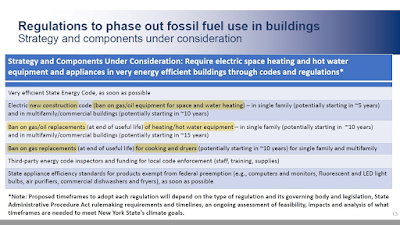
The Energy Efficiency and Housing Advisory Panel is a subcommittee of the Climate Action Council empowered by the ambitious New York Climate Leadership and Community Protection Act of 2019. The proposed gas bans are phased-in over the next 5 to 15 years in order to meet the Act's climate goals.
This command and control policy won't achieve the goals without serious unintended consequences. Consumers will rush to purchase and install gas technologies before the new bans take effect, undermining the purpose of the ban. Concurrent policies to increase the share of renewable wind and solar energy are being implemented, making electricity more expensive in NY. Importantly, relying solely on electricity for space heating puts NY residents in drafty buildings at risk from freezing during a blackout.
Such a shift in the way New Yorkers operate all their aging buildings in this short timeframe is improbable. Current technology being pushed comes in the form of all-electric ground-source heat pumps and cold climate air-source heat pumps. While these technologies are capable of providing comfortable interior environments in the context of holistic building design under normal operating conditions, they are expensive to install and maintain.
During the recent public comment period for the gas ban proposal, serious doubts were put forth regarding the functionality of alternative technologies in a variety of circumstances. Simply replacing gas burning furnaces and appliances with all-electric options may not work as intended. In the absence of super-insulated and tightly sealed building envelopes, heat pumps lose heat transfer efficiency in cold temperatures and need to run continuously. Their compressor oil needs to be heated by electric resistance to avoid mechanical failure. At extremely low temperatures, electric resistance backup heat is required, which is the least efficient and most expensive to operate. These factors put a greater load on the electric grid when it's needed most, increasing the risk of catastrophic failure and expense of operation. Heat pumps may not be able to keep up in some extreme conditions, such as a polar vortex, which climate models increasingly forecast.
A better policy approach is to continue to provide market incentives to encourage those who want and can afford all efficient technologies, including gas combined heat and power systems and climate-negative biofuels, to install them more easily. Funding research and development for future innovative solutions, such as better performing refrigerants, should be increased in an effort to make our buildings and energy systems better.
~ Mark Bremer, Green Explored contributor
(1) Energy Efficiency and Housing: Public Engagement Session presentation, February 4, 2021. https://climate.ny.gov/-/media/CLCPA/Files/2021-02-04-EEH-Public-Engagement-Session.pdf

I wrote this email this morning to Jigar Shah who heads DOE $40 billion loan program and Michael Regan who heads the US EPA.
Jigar and Mr. Regan
Bloom Energy the largest ecofraud of the 21st century has been fined by the EPA for Hazmat. The EPA does not trust Bloom to police itself and there will be an Independent Auditor over the Hazmat.


